Types of DNA-derived data

DNA Data and Darwin Core: The DNA Derived Data Extension

Elizabeth Lawrence, Emilie Boulanger, Saara Suominen

2026-07-22

Five DNA data categories

Which one fits your data?

# Category Example
1 DNA-derived occurrences Metabarcoding (ASVs/OTUs assigned to taxa)
2 Enriched occurrences Voucher specimen + barcoded
3 Targeted species detection qPCR / ddPCR assays
4 Name references Sequence in GenBank only
5 Metadata only Dataset without sequences

🔎 Use the GBIF decision tree to confirm your category

eDNA data standards

Two major eDNA data standards exist

  1. MiXS
    (Minimum Information about any (x) Sequence) — for raw sequences in NCBI
  1. Darwin Core (DwC)
    Community vocabulary for biodiversity data — species, location, date, basis of record

OBIS + GBIF + ALA accept genetic data linked to spatial coordinates and time


🔜Developing landscape

  • Rapidly changing field
  • For OBIS future directions include the DWC-DP and FAIReDNA terms

Darwin Core + DNA Derived Data Extension

  • Darwin Core: shared vocabulary for biodiversity data
  • DNA Extension: adds MIxS terms for sequences, primers, methods
  • Developed jointly by GBIF, OBIS, and the genomics community
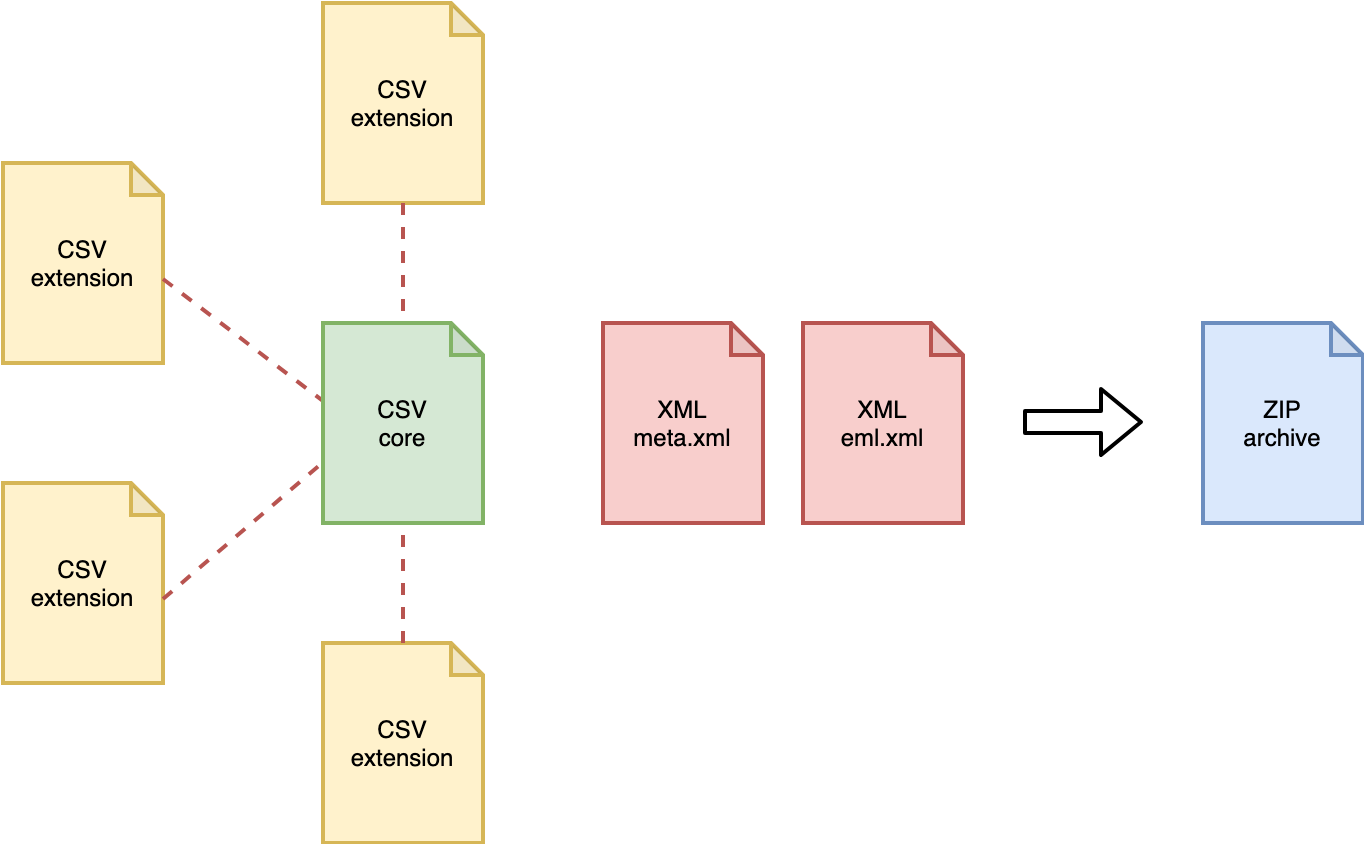
meta.xml ← links all tables
eml.xml ← metadata (who, what, where, when, how)
occurrence.csv ← the occurrence records
dna_derived.csv ← the DNA extension

Core table for DNA data

DNA data can be published with either core type:

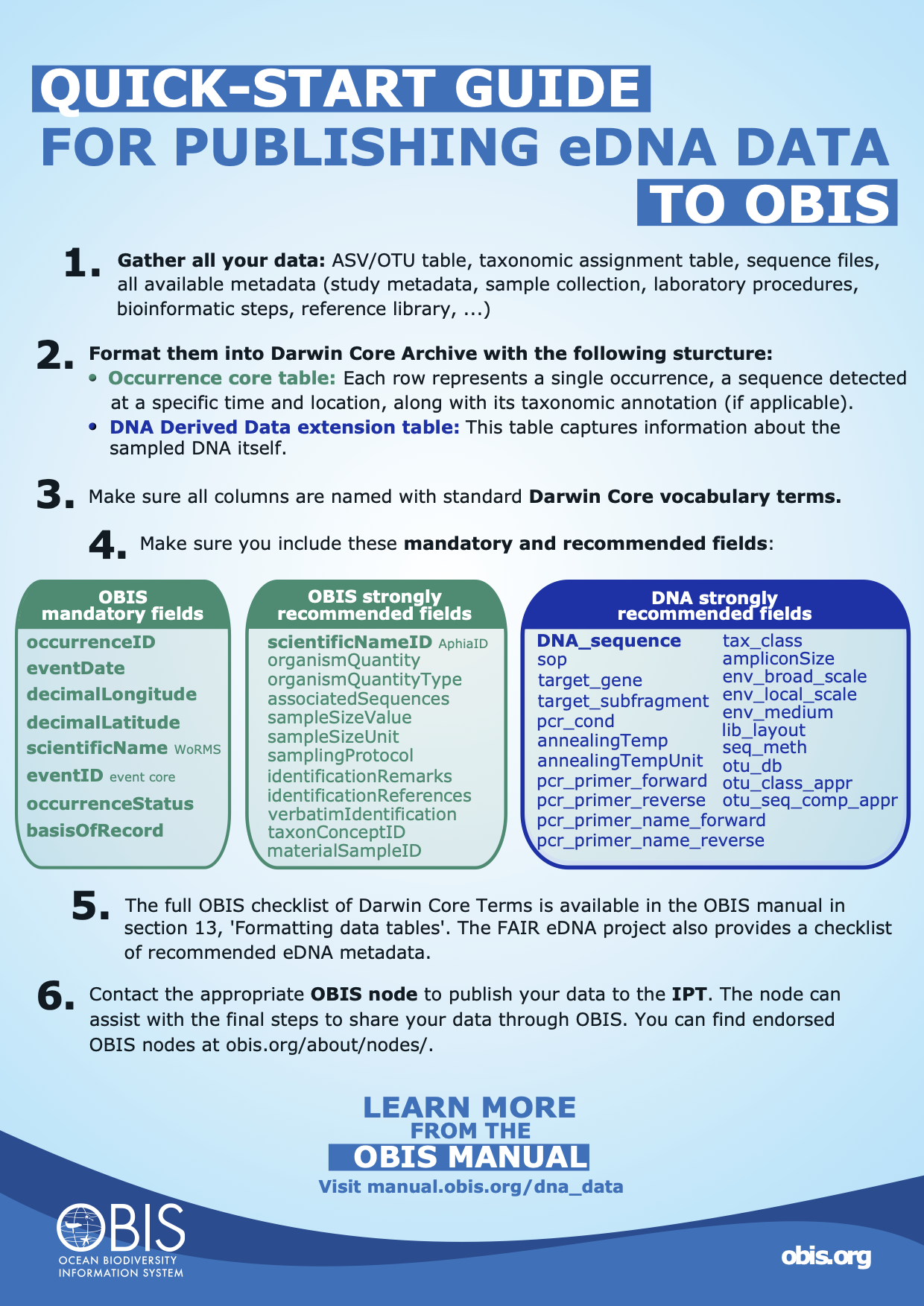
  • Occurrence core + DNA extension
  • Event core + Occurrence extension + DNA extension

This wasn’t always true

Previously guidance required Occurrence core only for DNA data. Event core support was added recently!

Key DwC fields to include: Event

Event core (mandatory fields)

  • eventIDunique, stable ID
  • eventDateYYYY-MM-DD
  • decimalLatitude, decimalLongitude

Event table (strongly recommended fields)

  • minimumDepthInMeters, maximumDepthInMeters
  • sampleSizeValue (volume of sample)
  • sampleSizeUnit (units of volume sampled)
  • samplingProtocol - (link to your field sampling SOP)

Key DwC fields to include: Occurrence

Occurrence (core) table (mandatory fields)

  • occurrenceIDunique, stable ID
  • scientificNametaxon name to lowest possible taxon rank
  • basisOfRecord = “MaterialSample”
  • occurrenceStatus = “present”

If Occurrence core, also: eventDate, decimalLatitude, decimalLongitude

Occurrence table (strongly recommended fields)

  • scientificNameID (WoRMS AphiaID)
  • organismQuantity (read count of sequence)
  • organismQuantityType = “DNA sequence reads”
  • sampleSizeValue (total read count in sample)
  • sampleSizeUnit = “DNA sequence reads”
  • samplingProtocol - (link to your SOP)
  • associatedSequences (link to e.g. GenBank or ENA accession)

Key fields to include: DNA Extension

DNA Extension (example key fields)

  • DNA_sequenceASV/OTU sequence
  • target_genee.g. “COI”, “18S rRNA”
  • pcr_primer_name_forwardand reverse
  • seq_methe.g. “Illumina MiSeq”
  • otu_class_appre.g. “DADA2 v1.18”
  • otu_dbreference database
  • soplink to your protocol

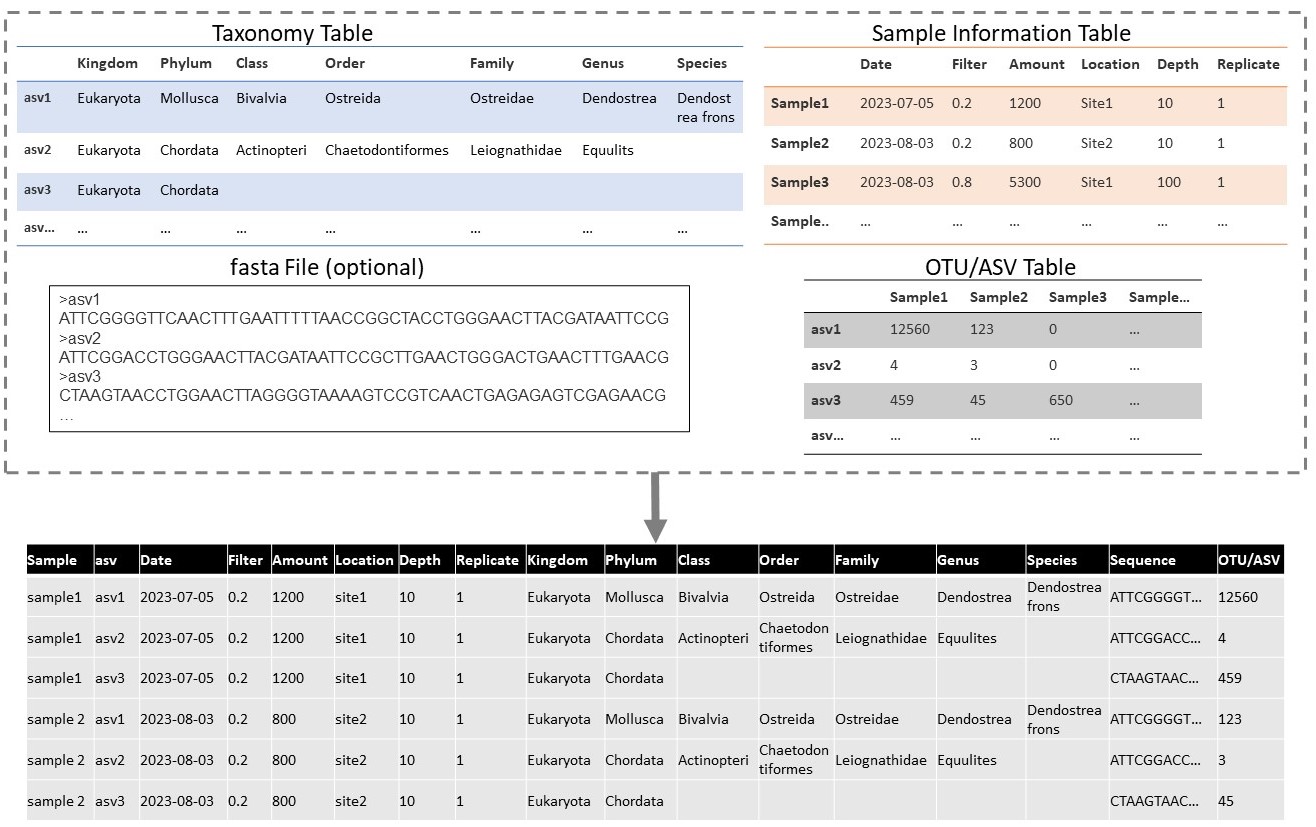
From raw outputs → long format

DNA data is more complex than a lat/lon + species name

Your typical metabarcoding outputs:

File Content
OTU/ASV table Sequences × Samples (read counts)
Taxonomy table Sequence [ID] → taxon assignment
Sample metadata Location, date, method
FASTA file Actual DNA sequences

The transformation:

One row = one unique sequence in one sample = one occurrence record

Example transformation

Table structure options

Option A — Occurrence Core

occurrence.csv 
  └── dna_derived.csv  (linked via occurrenceID)
  └── emof.csv         (linked via occurrenceID)

Option B — Event Core (recommended for eDNA)

event.csv
  └── occurrence.csv        (linked via eventID)
       └── dna_derived.csv  (linked via occurrenceID)
  └── emof.csv              (linked via eventID or occurrenceID)

Why Event Core? Sample-level metadata (location, date, method) is recorded once per sampling event rather than repeated in every row.

Dataset Structure: Three Linked Tables

Event Core

  • eventID
  • eventDate
  • decimalLatitude
  • decimalLongitude
  • samplingProtocol

→ the 📍where, 🕒when & 🧪how of collection

Occurrence Extension

  • occurrenceID
  • eventID
  • scientificName
  • taxonID (WoRMS)
  • basisOfRecord
  • occurrenceStatus

→ what organism was detected 🐠🪸🪼

DNA Derived Data Ext.

  • occurrenceID
  • DNA_sequence
  • target_gene
  • pcr_primer_forward
  • pcr_primer_reverse
  • seq_meth

→ 🧬the molecular context


Tables linked by eventID and occurrenceID

Optional 4th table: eMoF for measurements and facts

eMoF extension table

  • Table to record all types of measurements (abiotic, biotic, environmental, sampling…)
  • Measurements recorded in long format
    • measurementType, measurementValue, measurementUnit
  • Linking sampling info to eventIDs decreases duplication
  • Use controlled vocabulary whenever possible!
eventID occurrenceID measurementType measurementValue measurementUnit
YEARsite1samp1 temperature 25 C
measurementTypeID measurementUnitID
http://vocab.nerc.ac.uk/collection/P01/current/TEMPPR01/ http://vocab.nerc.ac.uk/collection/P06/current/UPAA/

Controlled Vocabulary

Identifiers for each eMoF column

  • measurementUnitID
  • measurementValueID
    • non-numeric values
  • measurementTypeID

→ Facilitates data understanding

→ Enables data aggregation

→ Decreases misuse potential

What should vocabulary terms capture?
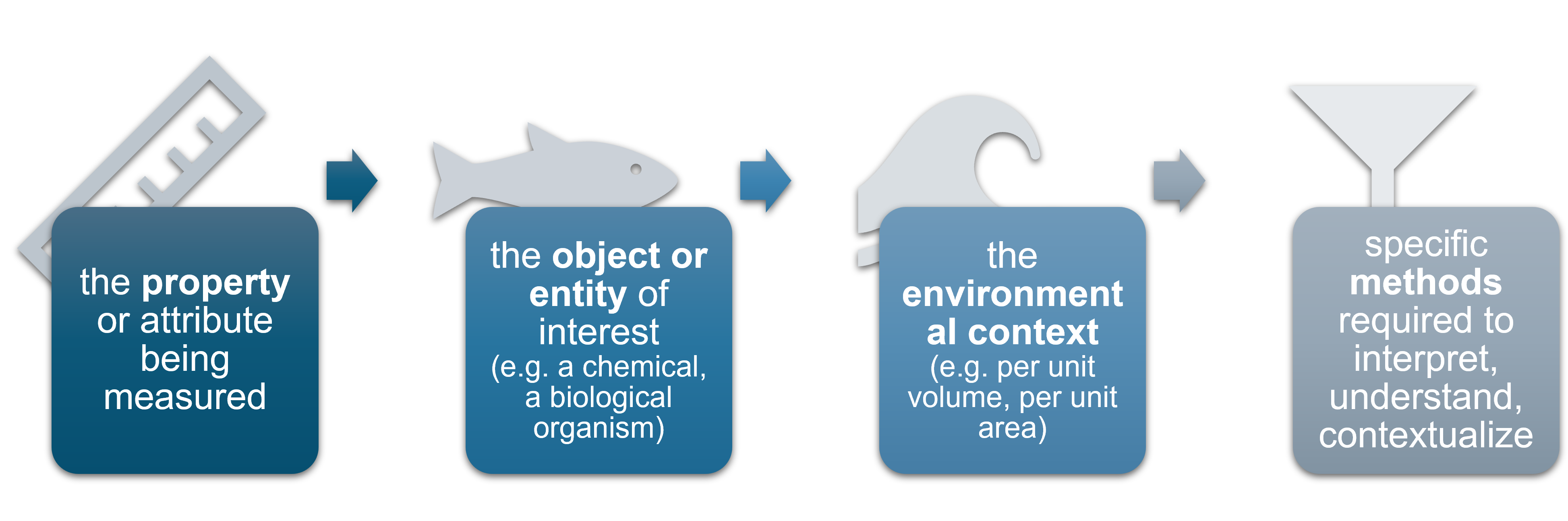
OBIS recommends using NERC vocabulary terms

DNA Derived Data Extension Summary

Managing DNA data with Darwin Core uses:

  • Event core (sampling event info)
  • Occurrence extension (taxon observation and identification)
  • DNA derived data extension (DNA sequences, primers, methods)
  • eMoF extension (other measurement or fact information)