Mobilizing Deep Ocean Biodiversity Data
Publishing eDNA to OBIS
2026-09-09
The eDNA Metabarcoding Workflow
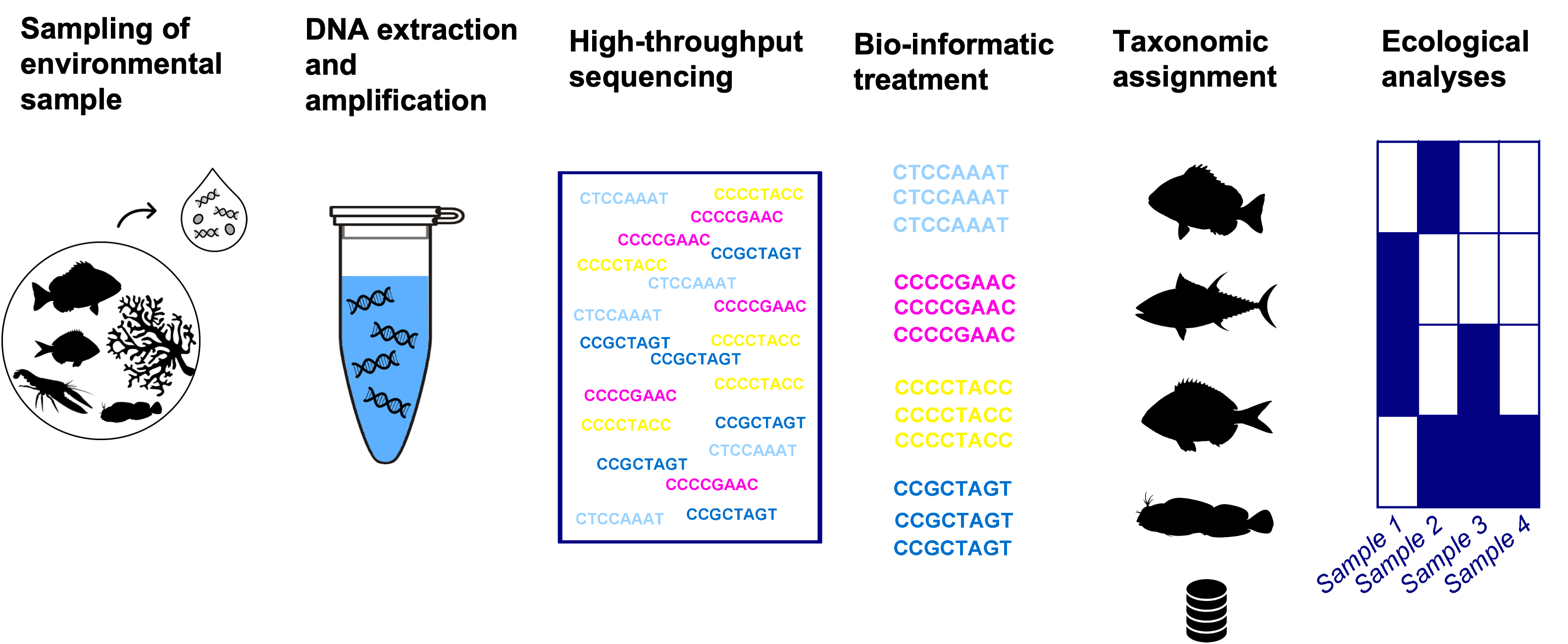
Figure adapted from NatureMetrics and Gill et al. 2016 · Emilie Boulanger
Most common eDNA data types you may encounter:
- eDNA Metabarcoding
- Quantitative PCR (qPCR)
The DNA publishing guide
Publishing DNA-derived data through biodiversity data platforms

Five DNA data categories
Which one fits your data?
| # | Category | Example |
|---|---|---|
| 1 | DNA-derived occurrences | Metabarcoding (ASVs/OTUs assigned to taxa) |
| 2 | Enriched occurrences | Voucher specimen + barcoded |
| 3 | Targeted species detection | qPCR / ddPCR assays |
| 4 | Name references | Sequence in GenBank only |
| 5 | Metadata only | Dataset without sequences |
Use the DNA Guidance decision tree to confirm your category
eDNA data in OBIS
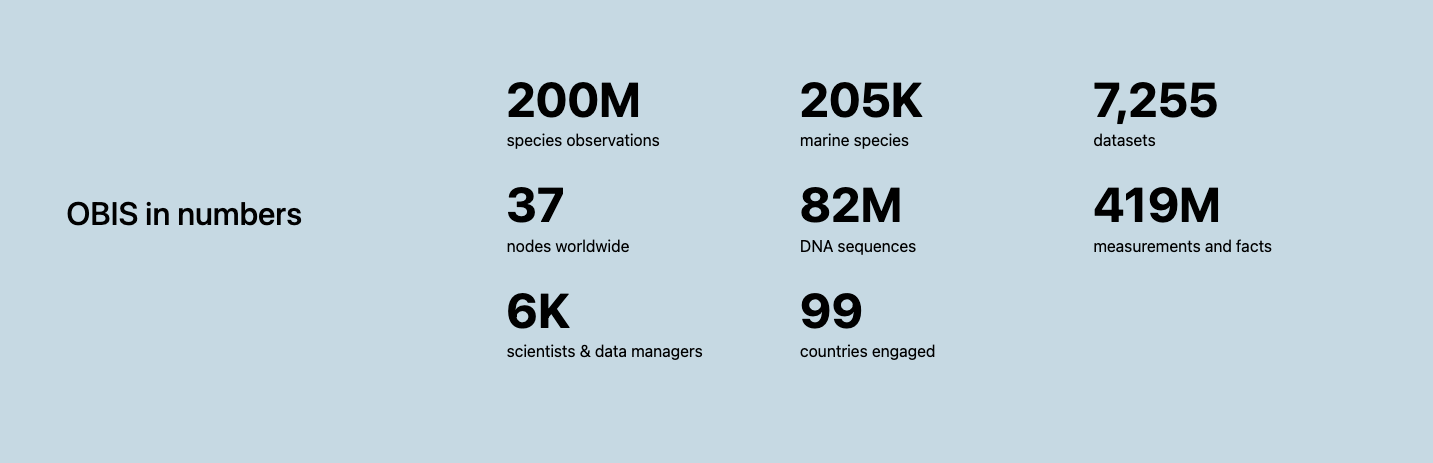
- OBIS currently holds 128 datasets with eDNA-derived occurrences, including 44,5 million records
- About 2 million distinct sequences
- That is 2% of all datasets, but 25% of all occurrence records in OBIS
OBIS DNA Data Management Platform
Through the eDNA Expeditions Project, OBIS is developing a data management platform for DNA data including:
- Bioinformatics
- QC
- Validation
- Publication to OBIS pipeline
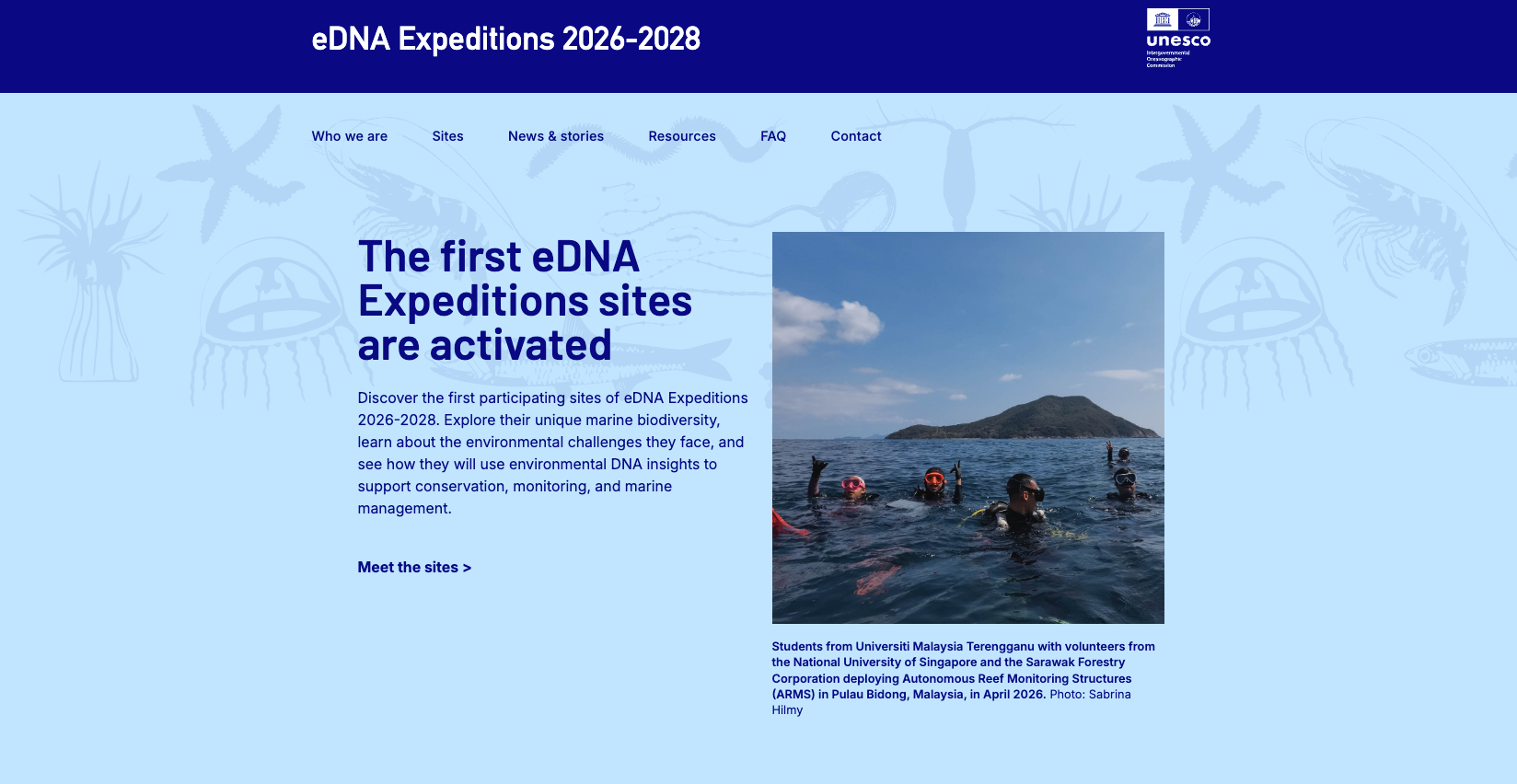
To be offered to OBIS nodes to support local eDNA projects! Learn more at https://ednaexpeditions.org/
Darwin Core + DNA Derived Data Extension
- Darwin Core: shared vocabulary for biodiversity data
- DNA Extension: adds MIxS terms for sequences, primers, methods
- Developed jointly by GBIF, OBIS, and the genomics community
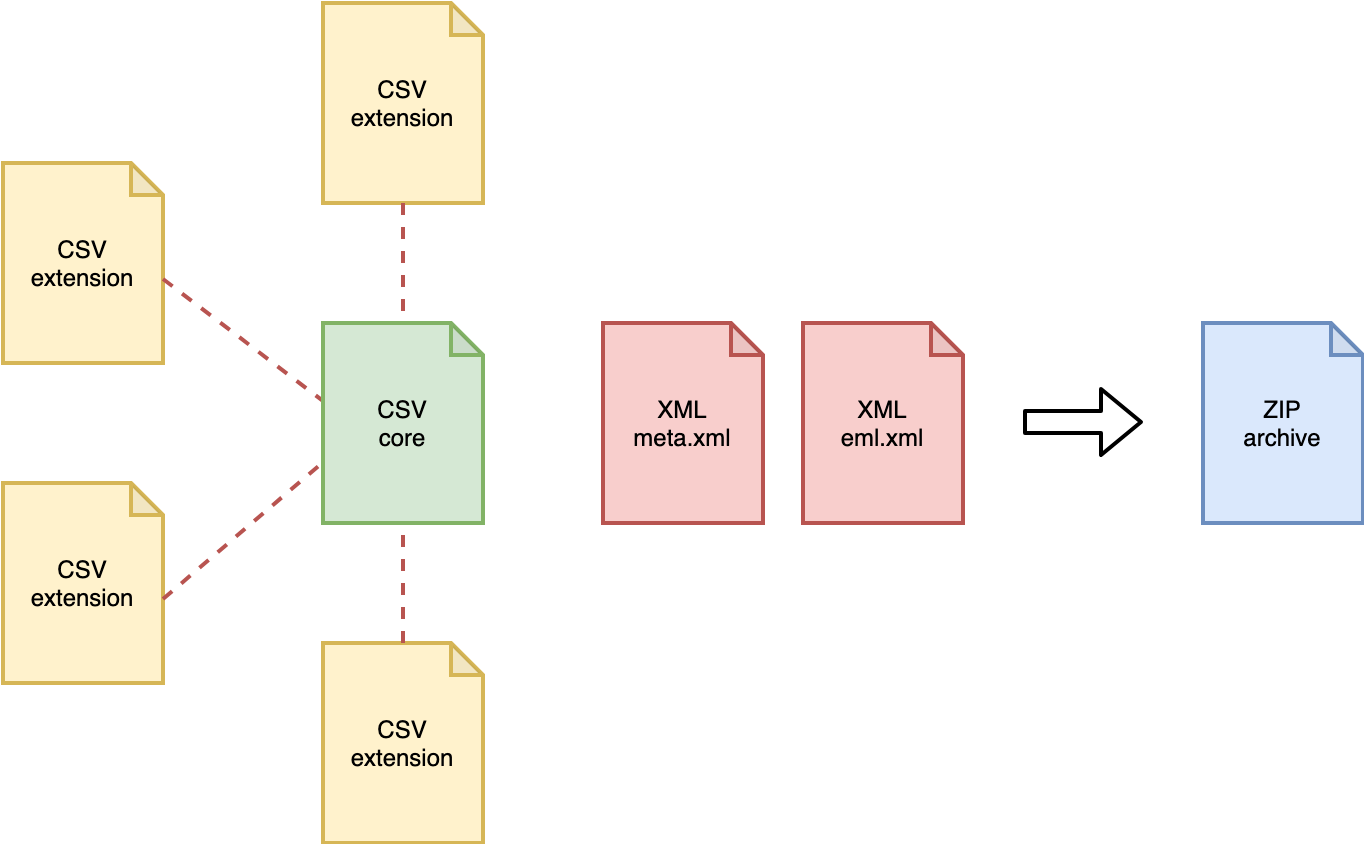
meta.xml ← links all tables
eml.xml ← metadata (who, what, where, when, how)
occurrence.csv ← the occurrence records
dna_derived.csv ← the DNA extension
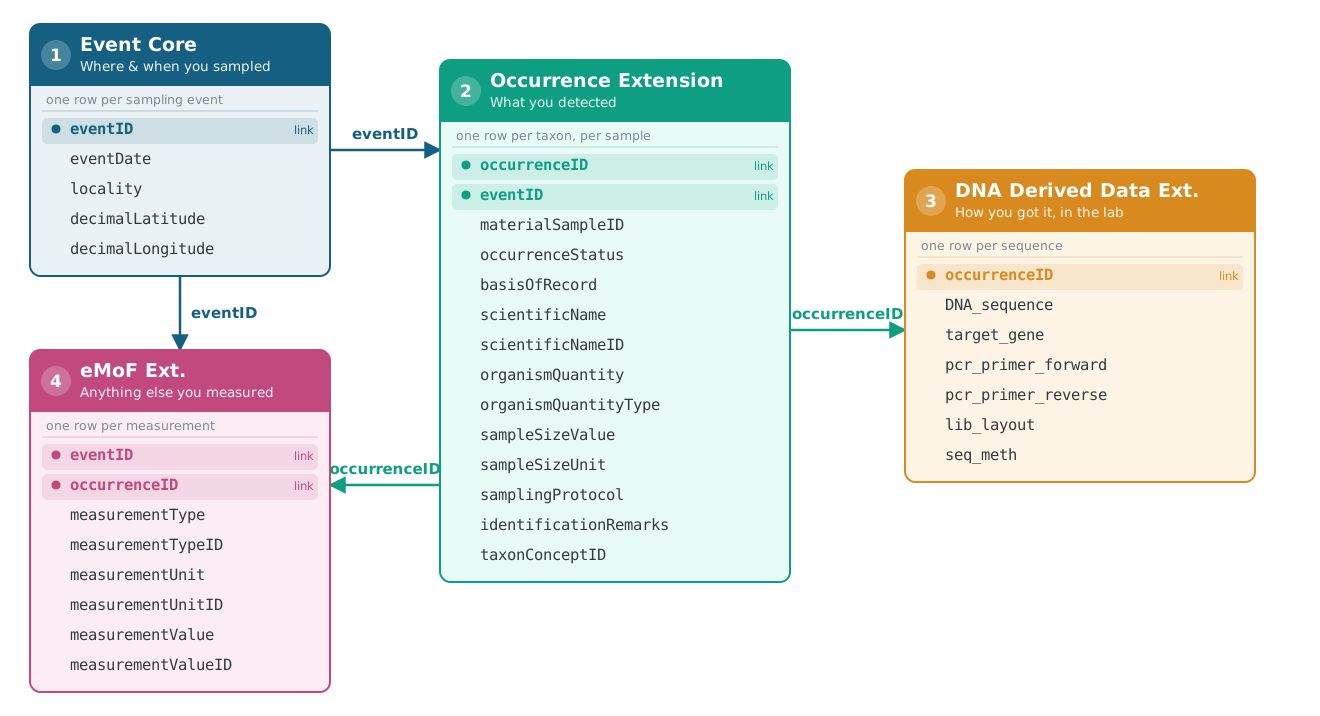
Two ways to structure the same dataset
Option A — Occurrence core
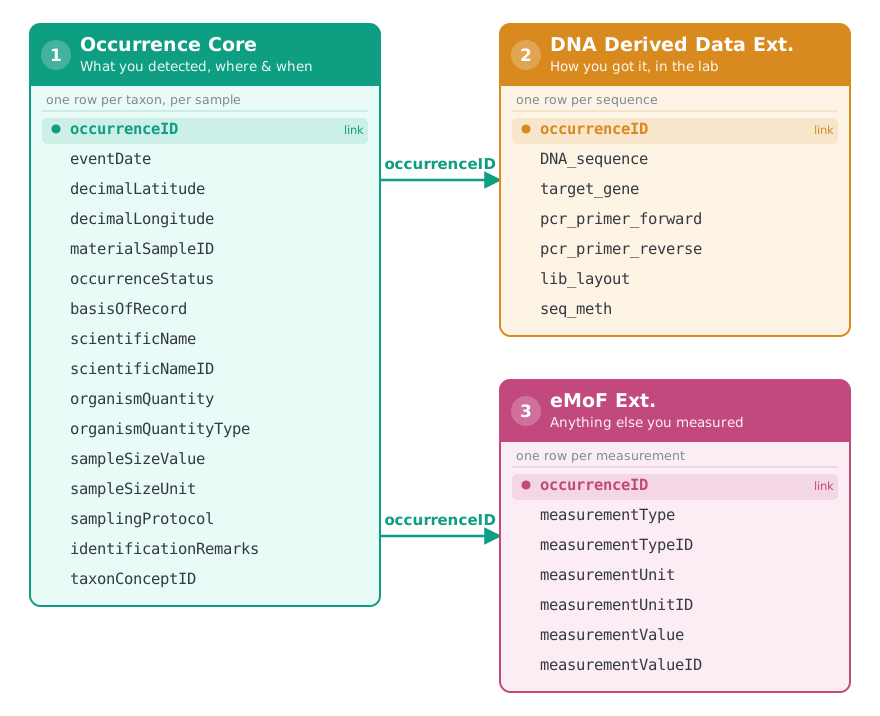
Option B — Event core
Key fields to include: DNA Extension
Required
occurrenceID— links to the occurrence row
Strongly recommended
DNA_sequence— ASV/OTU sequencetarget_gene— e.g. “COI”, “18S rRNA”target_subfragment— e.g. “V4”env_broad_scale— biomeenv_medium— what was sampled
Strongly recommended, cont.
pcr_primer_name_forward— and reversepcr_primer_name_reversepcr_primer_forward— the sequence itselfpcr_primer_reversepcr_primer_reference— where the primer pair is published
Recommended
seq_meth— e.g. “Illumina MiSeq”otu_class_appr— e.g. “DADA2 v1.18”otu_db— reference databasesop— link to your protocolsamp_vol_we_dna_ext— volume sampled
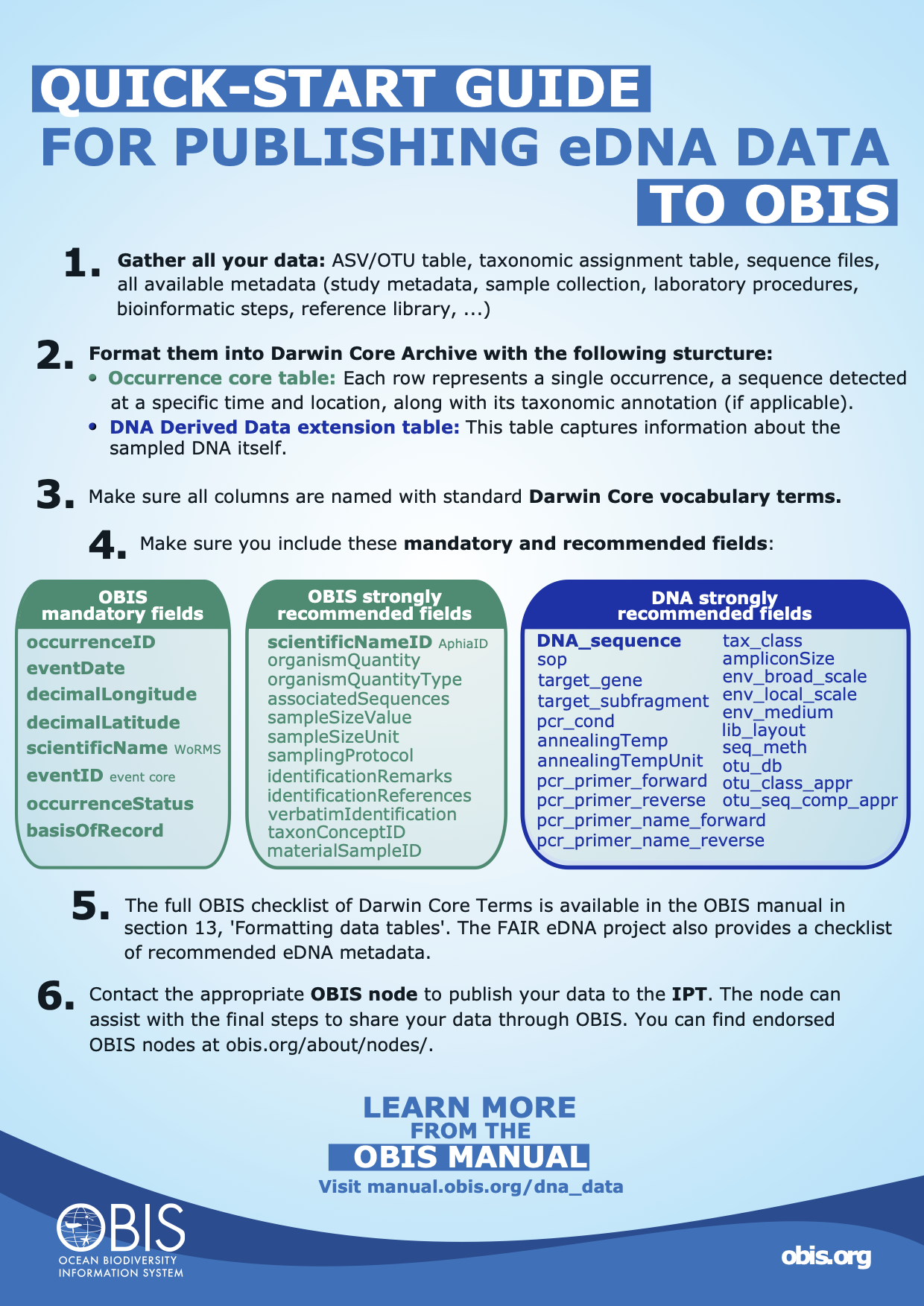
These are the fields you will use most — the full OBIS list of required and recommended terms is at manual.obis.org/checklist.html
Event Modeling
Take 10 minutes, and in groups discuss/draw how Pedro should model his data in his event table + occurrence core.
Example Data Publishing Schematic
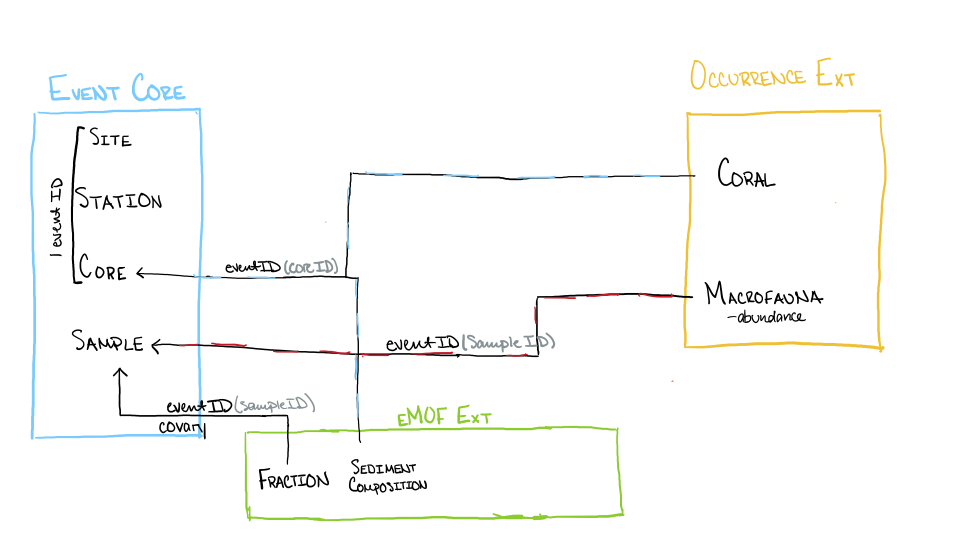
Example Scientific Schematic
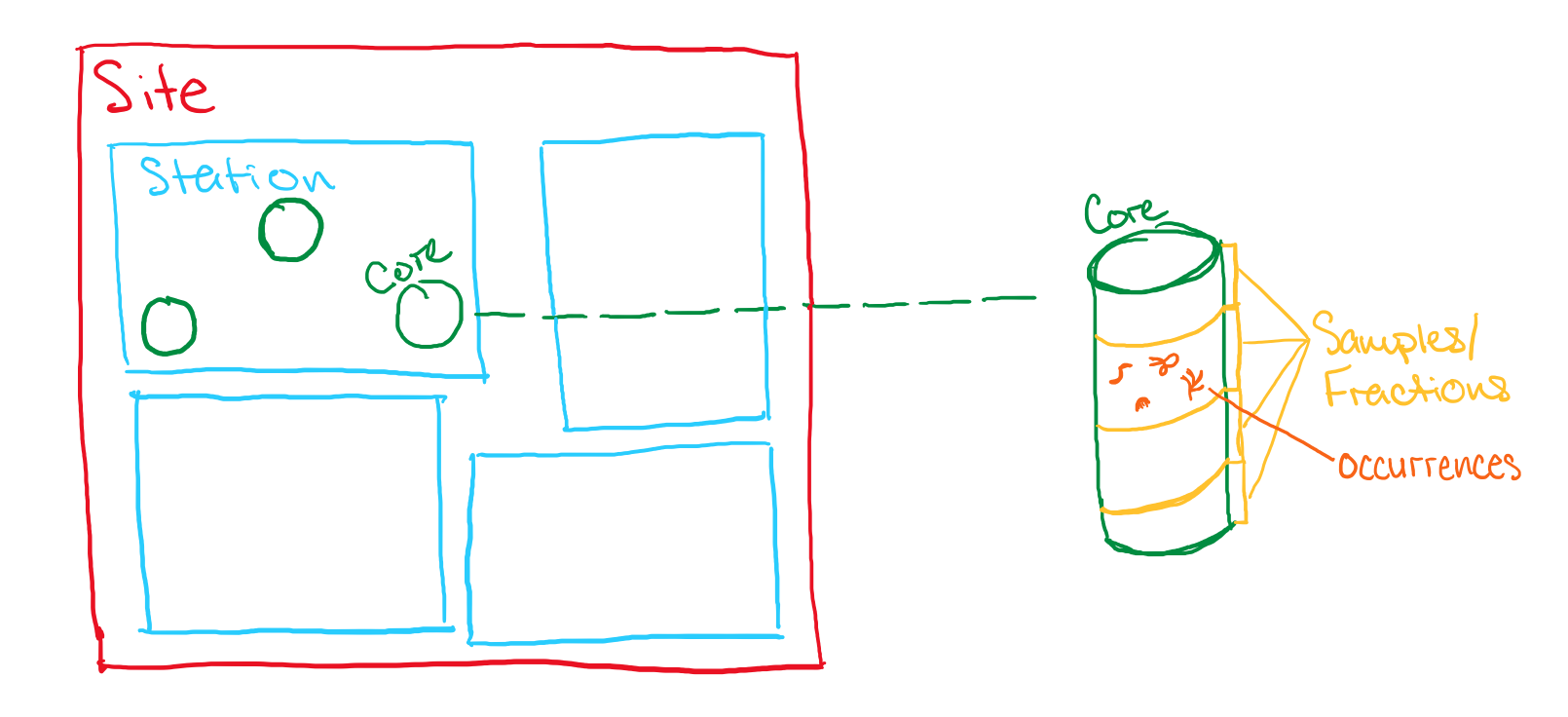
Hand-drawn data visualization of relationships, with light grey text indicating variable names provided by the data collectors, Image by Kylie Hollis, License CC0
From raw outputs → long format
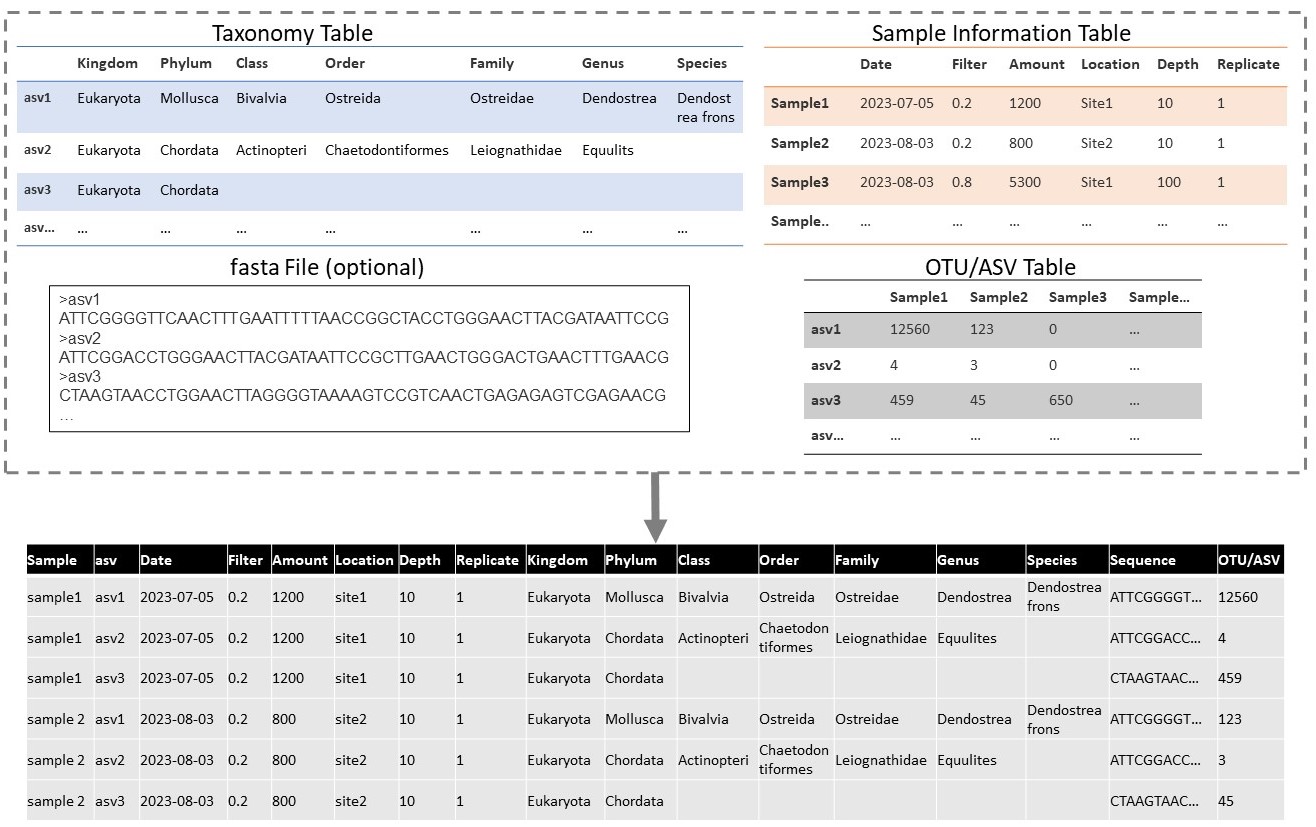
The transformation:
One row = one unique sequence in one sample = one occurrence record
Laura’s Elegant Solution: MDT to IPT

Unknown sequences
- Many sequences in any given study will remain uncharacterized
- Populate the
scientificNamefield with Biota incertae sedis - Or the lowest taxonomic information if available
- e.g. only assigned to Class level,
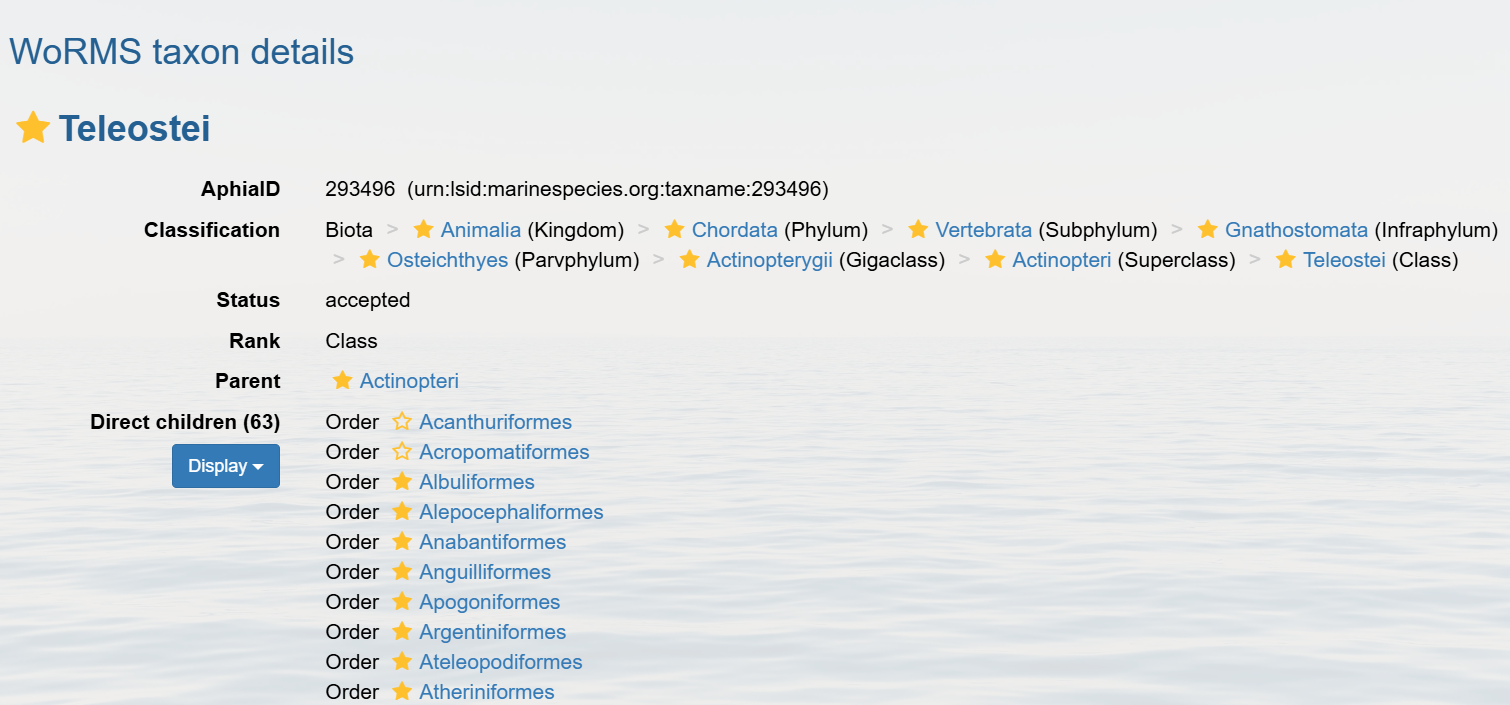
scientificName= Teleostei,scientificNameID= urn:lsid:marinespecies.org:taxname:293496
- e.g. only assigned to Class level,
- For Biota incertea sedis,
scientificNameIDshould be populated with urn:lsid:marinespecies.org:taxname:12. - Recommend that you populate
verbatimIdentificationwith the name that was originally documented (e.g. phototrophic eukaryote).
Metadata with no DwC terms
- A lot of information, especially detailed parameters e.g. of bioinformatic workflow, do not have controlled vocabulary fields yet
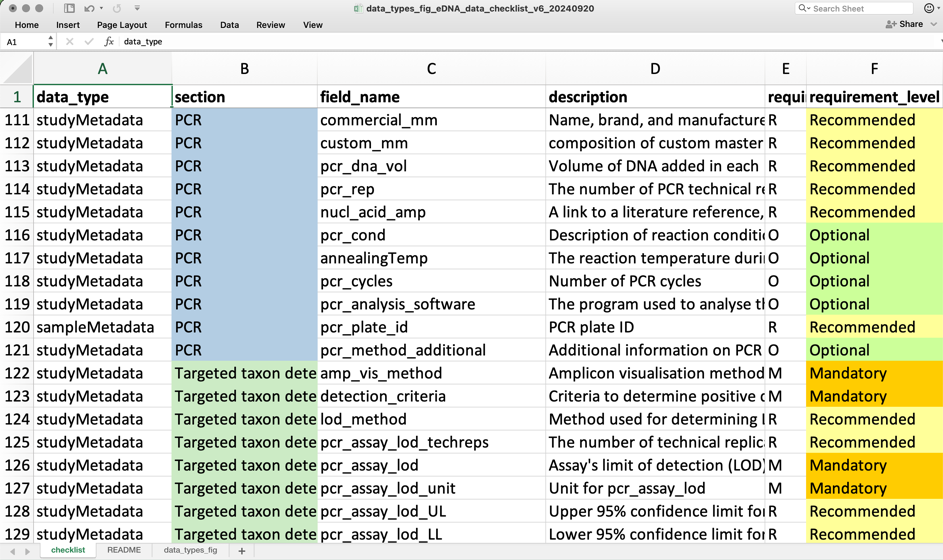
- The FAIRe project, “making eDNA data FAIR”, is in the process of developing new metadata fields to record all the relevant information of eDNA projects
- The checklist is already available online: https://fair-edna.github.io/download.html
- A lot of existing fields, a lot of new fields
- Currently, the new fields are dropped from the IPT. But in the process of adding them to DwC and MIxS.
The DNA publishing guide
Publishing DNA-derived data through biodiversity data platforms