Mapping molecular data to Darwin Core

Which information is entered where?

Elizabeth Lawrence, Emilie Boulanger, Saara Suominen

2026-07-22

Identifying key information for Metabarcoding & qPCR pipelines

eDNA Metabarcoding: Key Information

Category 1 — DNA-derived occurrences — basisOfRecord = MaterialSample

From field collection to taxonomy — what to capture at each step

Step 1:⛵ Field Sampling

Field Sampling Maps to
Coordinates, location names Event table: decimalLatitude, decimalLongitude, locality
Date, time Event table: eventDate, eventTime
Environmental measurements (temperature, salinity, depth…) eMoF table: measurementType, measurementValue, measurementUnit
Sampling method / gear Event table: samplingProtocol and/or eMoF table
Sample volume, filter size DNA table: samp_size , size_frac

eDNA Metabarcoding: Key Information

Category 1 — DNA-derived occurrences — basisOfRecord = MaterialSample

From field collection to taxonomy — what to capture at each step

Step 2: 🧬 DNA Extraction

DNA Extraction Maps to
Volume of sample processed DNA table: samp_vol_we_dna_ext
Extraction method / kit DNA table: nucl_acid_ext, nucl_acid_amp
Concentration DNA table: concentration, concentrationUnit
Purity ratio (A260/280) DNA table: ratioOfAbsorbance260_280

eDNA Metabarcoding: Key Information

Category 1 — DNA-derived occurrences — basisOfRecord = MaterialSample

From field collection to taxonomy — what to capture at each step

Step 3: 🧪 DNA Amplification

DNA Amplification Maps to (DNA table)
Target gene (e.g. COI, 18S rRNA) DNA table: target_gene
Primer sequence + primer reference DNA table: pcr_primer_forward, pcr_primer_name_forward, pcr_primer_reverse, pcr_primer_name_reverse + pcr_primer_reference
PCR conditions DNA table: pcr_cond
Length of amplified product DNA table: ampliconSize

eDNA Metabarcoding: Key Information

Category 1 — DNA-derived occurrences — basisOfRecord = MaterialSample

From field collection to taxonomy — what to capture at each step

Step 4: 💻 Sequences

Sequences Maps to
Sequencing platform + library layout DNA table: seq_meth + lib_layout
Sequences per sample DNA table: DNA_sequence (linked by occurrenceID)
Public repository where sequences deposited (NCBI, ENA) Occurrence table: associatedSequences

eDNA Metabarcoding: Key Information

Category 1 — DNA-derived occurrences — basisOfRecord = MaterialSample

From field collection to taxonomy — what to capture at each step

Step 5: 🐠 Taxonomy

Taxonomy Maps to
Taxonomy assignment + annotation confidence Occurrence table: scientificName, taxonID
DNA table: annot
Reference database + pipeline used Occurrence table: identificationRemarks, identificationReferences
DNA table: otu_db + sop
Number of sequence reads per taxon & total Occurence table: organismQuantity, organismQuantityType, & sampleSizeValue, sampleSizeUnit

Key Metadata: Quantitative PCR (qPCR)

Category 3 — Targeted species detection — basisOfRecord = MaterialSample

Targeted species detection — additional fields vs metabarcoding

⛵ Step 1: Field Sampling → same as metabarcoding

🧬 Step 2: DNA Extraction → same as metabarcoding

🧪 Step 3: DNA Amplification → PCR conditions → pcr_cond

🎯 Step 4/5: Target & Quantity

Target & Quantity Maps to
Target gene region target_gene, target_subfragment
Primers pcr_primers
Copy number + concentration estimatedNumberOfCopies + concentration, concentrationUnit
LOD, Cq, baseline pcr_primer_lod, quantificationCycle, baselineValue

Special cases

Unknown sequences

  • Many sequences in any given study will remain uncharacterized
  • Populate the scientificName field with Biota incertae sedis
  • Or the lowest taxonomic information if available
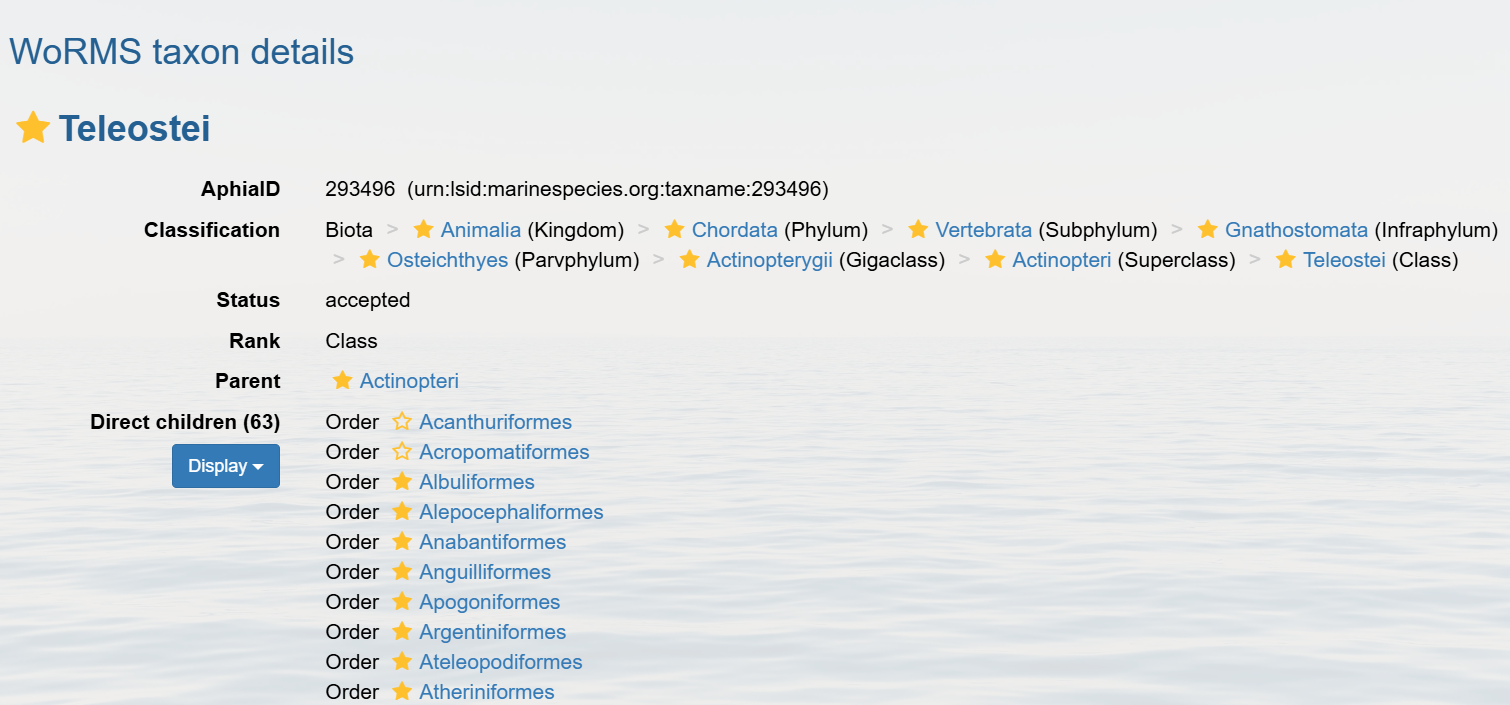
    • e.g. only assigned to Class level, scientificName = Teleostei, scientificNameID = urn:lsid:marinespecies.org:taxname:293496
  • For Biota incertea sedis, scientificNameID should be populated with urn:lsid:marinespecies.org:taxname:12.
  • Recommend that you populate verbatimIdentification with the name that was originally documented (e.g. phototrophic eukaryote).
Sequences without a WoRMS ID (AphiaID)

  • WoRMS is an extensive database of linnean names of marine species, confirmed by experts in each taxonomic group
  • Within eDNA datasets there are usually many taxonomic assignments (protists, prokaryotes) that cannot be found in the WoRMS database currently (i.e. no AphiaID available)
  • The name might be available and mapped to GBIF, making sharing datasets between GBIF and OBIS complicated
  • The submitter of the data may in these cases record the known species name, in scientificName, the ID of the taxon in another database in taxonConceptID and leave scientificNameID empty

Control samples

  • Control samples are important for quality control of resulting data
  • Currently, there is no feature for this implemented in the IPT
  • In the future, OBIS and GBIF are working on a solution to submit them as separate files within the same dataset
  • They will then not be mapped, to avoid that they end up in the GBIF or OBIS occurrence indexes, but will be available for anyone looking for that information

Metadata with no DwC terms

  • A lot of information, especially detailed parameters e.g. of bioinformatic workflow, do not have controlled vocabulary fields yet
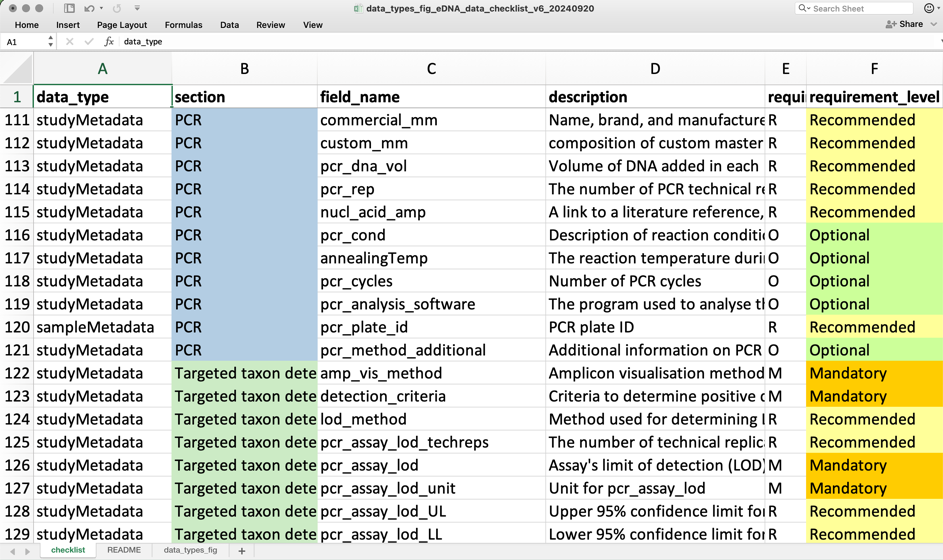
  • The FAIRe project, “making eDNA data FAIR”, is in the process of developing new metadata fields to record all the relevant information of eDNA projects
  • The checklist is already available online: https://fair-edna.github.io/download.html
  • A lot of existing fields, a lot of new fields
  • Currently, the new fields are dropped from the IPT. But in the process of adding them to DwC and MIxS.

Resources for DNA terms

Resource Link
DNA Extension term definitions rs.gbif.org/extension/gbif/1.0/dna_derived_data_2024-07-11.xml
DwC Term Quick Reference Guide dwc.tdwg.org/terms/
OBIS Manual (DNA chapter) manual.obis.org/dna_data.html
GBIF DNA publishing guide doi.org/10.35035/DOC-VF1A-NR22