| # | Episode | Description | Time |
|---|---|---|---|
| 1 | Introduction to eDNA & Biodiversity Data | A conceptual introduction to what eDNA is and how it becomes biodiversity data. | ~60 min |
| 2 | OBIS & Darwin Core: What They Are and Why They Matter | Meet OBIS, the global network behind it, and see why publishing your eDNA data through it matters. | ~60 min |
| 3 | Data Standards for eDNA: DwC-A, MIxS, and the DNA Derived Data Extension | Learn the vocabulary and table structures that turn raw sequencing outputs into a publishable Darwin Core Archive. | ~60 min |
| 4 | Structure an eDNA Dataset | Transform raw DNA data into a Darwin Core-compliant dataset. | ~90 min |
| 5 | Metadata: Field Sampling, Protocols, and Documentation | One sentence description. | ~60 min |
eDNA Data Management Course
Foundations
Overview
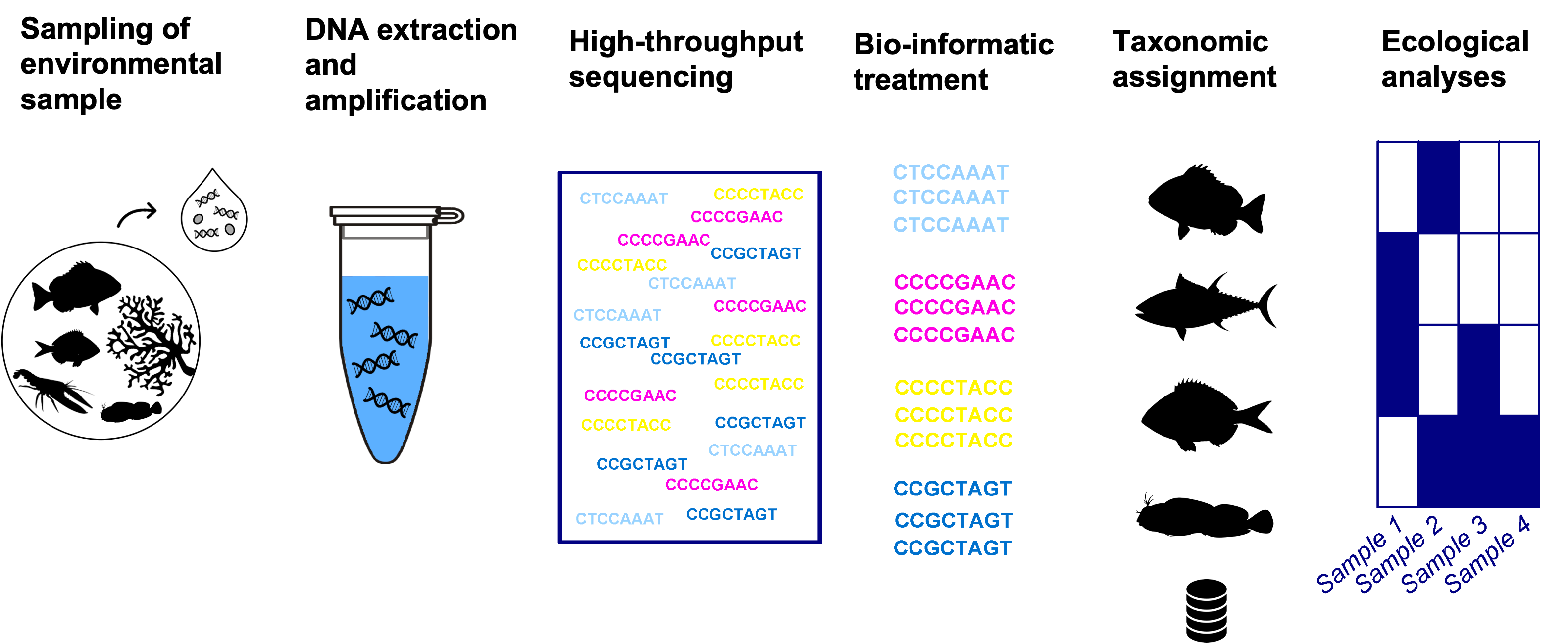
This online course is aimed at beginners who are new to publishing eDNA data to OBIS and GBIF. It is meant to provide an introduction to DNA data and its management. We cover topics including background information on what eDNA is, the key aspects of collecting, extracting, and sequencing DNA data, and an example of how to format DNA data table outputs into Darwin Core for publishing to OBIS.
This course is not meant to provide advanced knowledge and instead focuses on providing a solid foundation for DNA data.
TipSupporting Slides
Supporting slides used by instructors can be found: https://iobis.github.io/obis_edna_slides/.
Learning outcomes
By the end of these lessons, you should be able to:
- Define environmental DNA (eDNA) and explain how it differs from traditional biodiversity surveys
- Understand the typical output from DNA pipelines - ASV tables, FASTA files for sequences, taxonomy files, and sample metadata - and how to load them into R.
- Explain the “wide to long” transformation from raw sequencing outputs to Darwin Core occurrence records.
- Combine DNA output tables into Darwin Core tables, mapping raw fields to Darwin Core terms.
- Describe how taxon matching against WoRMS works, and what to do when a sequence has no match.
Prerequisites
Episodes
Setup
Most of the content in this course is conceptual, however Episode 4 provides a data formatting example with R. Before the fourth episode, please complete the Setup instructions. These cover software installation, package installation, and downloading the example dataset.
How to use these materials
These materials can be used for self-paced study or as part of an instructor-led workshop.
- Self-paced: Work through each episode in order.
- Instructor-led: Your instructor will guide the pace. Exercises will be worked through together or in small groups.
Tip boxes, challenge boxes, and key-point summaries appear throughout. Take time to read them - they highlight common mistakes and the most important concepts.
Acknowledgements
This course was developed as part of the Ocean Biodiversity Information System (OBIS) training programme.
Lesson design follows the pedagogical framework of The Carpentries, whose Curriculum Development Handbook informed the structure of these materials. Content is original and independent; this is not an official Carpentries lesson.
Maintained by OBIS. Licensed CC BY 4.0.
This lesson was last rendered on 2026-07-23.